| |||
| I have a very simple question for you… If you were going to limit all of your investments to only one sector of the economy – only one type of business or one kind of stock – what would you buy? We've come to believe that, for outside and passive investors (common shareholders), there are very few sectors that offer truly extraordinary rates of return and that don't require taking any material risk. Let me be clear about what I mean. There are only a few sectors of the economy where companies can establish and maintain a truly lasting competitive advantage and outside investors can identify attractive values. As I teach my children about investing, I will focus almost entirely on examples from these sectors. And truly… I will spend most of my time explaining only one business to my children. If they come to understand this business thoroughly, I know, with a reasonable amount of saving discipline, they will be financially secure by the time they are 30 years old… and wealthy long before they reach 50. In today's essay, I'm going to explain what we see in this sector of the stock market. I want to show you why the investment returns are so incredibly good over the long term. I want you to know how to think about these businesses… how they work… and know a few simple keys to making great investments in this sector. I promise… this is all far easier than you're imagining right now. And I'm sure you'll want to print this essay, put it in a binder, and refer to it from time to time. Let's start with this chart… ------------------------------  This chart shows four of the best-managed insurance companies in the United States. Company No. 1 got its start insuring contact lenses and now it mostly insures things that other companies won't touch, like oil rigs and summer camps. It's a pretty small public company, worth about $2 billion. Company No. 2 was founded by a Harvard graduate just out of college about 40 years ago. It is still mostly a family business (even though it has public shareholders and is worth $6 billion). It insures almost anything commercial, from yachts to elevators. Company No. 3 is one of the world's largest insurance companies. It insures everything – homes, cars, boats, weddings (yes, weddings), etc. It is worth $33 billion. And Company No. 4 is a major global company that (again) insures virtually anything and is worth $22 billion. You might think, outside of being in the insurance industry, these companies have almost nothing in common. Some are very small and insure essentially niche items. Others are huge, operate globally, and insure virtually anything. Yet to us, these companies look nearly the same: They are among the very best underwriters in the world. That means these insurance companies almost always demand more in insurance premiums than they will end up spending on insurance claims. As you will soon learn, there's probably nothing more valuable in the financial world than having the skill and the discipline to underwrite insurance profitably. Over the long term, all of these companies have generated returns that are more than double the S&P 500. They did so without taking any risk – something I'll explain more fully below. And… here's the best part… their success was both inevitable and repeatable. These are not "lucky guesses" or fad-driven product sales. One of our overriding goals at Stansberry & Associates Investment Research is to give you the knowledge we'd want to have if our roles were reversed. Knowing what I know now about finance, I wouldn't have gotten into the investment newsletter business. I would have gotten into insurance. There is nothing more valuable we can teach you than understanding how to invest in good insurance companies. And with the legwork we do in our Insurance Value Monitor (a part of our Stansberry Data service), it's as easy as pointing and clicking. If a company passes our tests and you can buy it at the right price… you can be next to 100% sure that the investment will produce outstanding returns. It's like painting by numbers. Only it will make you rich. Let me say it one more time… I believe if individuals would limit themselves to only investing in insurance companies – and no other sector – they would greatly increase their average annual returns. We don't believe that's true of any other sector of the market. There's a simple reason for this. If you'll think about it for a minute, it should become intuitive. Here's why insurance is the world's best business: Insurance is the only business in the world that enjoys a positive cost of capital. In every other business, companies must pay for capital. They borrow through loans. They raise equity (and must pay dividends). They pay depositors. Everywhere else you look, in every other sector, in every other type of business, the cost of capital is one of the primary business considerations. Often, it's the dominant consideration. But a well-run insurance company will routinely not only get all the capital it needs for free, it will actually be paid to accept it. I want to make sure you understand this point. All of the people who make their living providing financial services – banks, brokers, hedge-fund managers, etc. – all of them pay for the capital they use to earn a living. Banks borrow from depositors, investors who buy CDs, and other banks. They have to pay interest for that capital. Likewise, virtually every actor in the financial-services food chain must pay for the right to use capital. Everyone, that is, except insurance companies. Now just follow me here for a second… Insurance companies take the premiums they've collected and they invest that capital in a range of financial assets. Assume, just for the sake of argument, that they earn 10% each year on their premiums. (That is, they make 10% on their underwriting.) And assume they invest only in the S&P 500… What do you think the average return on their assets will be each year? In this hypothetical example, their return would be 10% plus whatever the S&P 500 returned. In reality, of course, few insurance companies can make such a large underwriting return. And few insurance companies invest a large percentage of their portfolio in stocks. Most stick to fixed income to make sure they can always pay claims. But the point remains valid. By compounding underwriting profits over time, year after year, into the financial markets, insurance companies can produce very high returns. And here's the best part: Insurance companies don't really own most of the money they're investing. They invest the "float" they hold on behalf of their policyholders. Float is the money they've received in premiums, but haven't paid out yet. Underwritten appropriately, this is a risk-free way to leverage their investments and can result in astronomical returns on equity over time. Just look at insurance company No. 1 in the chart above. It has produced eight times the S&P 500's long-term return. Can you think of any investor, anywhere, who has done anything like that? There isn't one. That kind of performance was only possible because, using a small equity base, the firm has invested profitably underwritten float into solid investments, year after year. Do you like paying taxes? Well, you won't like insurance stocks, then. They have huge tax advantages. Insurance is, far and away, the most tax-privileged industry in the world. Many of their investment products are totally protected from taxes. And their earnings are sheltered, too. Insurance companies don't have to pay taxes on the cash flow they receive through premiums because, on paper, they haven't technically earned any of that money. It's not until all of the possible claims on the capital have expired that the money is "earned." So unlike most companies that have to pay taxes on revenue and profits before investing capital, insurance companies get to invest all of the money first. This is a stupendous advantage. It's like being able to invest all of the money in your paycheck – without any taxes coming out – and then paying your tax bill 10 years from now. I realize that I can't make you (or anyone else) actually invest in insurance stocks. And I know that no matter what I say, most of you – probably more than 90% – never will. It's a tough industry to understand, filled with financial concepts and tons of jargon. But there are two reasons the smartest guys in finance wind up in insurance, one way or another… First, it pays the best. And second, it takes real genius to understand. But… my goal is to make it so easy to understand and follow that any reasonably diligent subscriber can do so. I'd urge you to read the March 2012 issue of my Investment Advisory newsletter for more details about how we analyze insurance stocks. In the meantime, I want to simply show you the one number you've got to know to invest safely and successfully. Normal measures of valuation don't apply to insurance companies. Why not? Because regular accounting considers the "float" an insurance company holds as a liability. And technically, of course, it is. Sooner or later, most (but not all) of that float will go out the door to cover claims. But because more premiums are always coming in the door, float tends to grow over time, not shrink. So in this way, in real life, float can be an important asset – by far the most valuable thing an insurance company owns. But there's one important catch… Float is only valuable if the company can produce an underwriting profit. If it can't, float can turn into a very expensive liability. That's why the ability to consistently underwrite at a profit is the key – the whole key – to understanding which insurance stocks to own. Outside of underwriting discipline, almost nothing differentiates insurance companies. And they have no other way to gain a competitive advantage. Warren Buffett – who built his fortune at Berkshire Hathaway largely on the backs of profitable insurance companies – explained this in his 1977 shareholder letter:
Thus, the basis of competition between insurance companies is underwriting. That is… to be successful, insurance companies must develop the ability to accurately forecast and price risk. And they must maintain their underwriting discipline even during "soft" periods in the insurance market when premiums fall. In our Insurance Value Monitor, we track nearly every major property and casualty insurance company in the U.S. and in Bermuda (where many operate to avoid U.S. corporate taxes completely). We rank every firm by long-term underwriting discipline. We've done the legwork for you. All you have to do is know what price to pay. So if normal accounting doesn't apply for insurance stocks, how do you value them? Again, we went to the master, Warren Buffett, to see what he was willing to pay for very well-run insurance companies. Bryan Beach, our lead insurance analyst, found data on three of Buffett's biggest insurance purchases. In 1998, he bought General Re for $21 billion, which added $15.2 billion to Berkshire's float and $8 billion in additional book value. So Buffett paid $0.94 for every dollar of float and book value. Before that, in 1995, Buffett bought 49% of GEICO for $2.3 billion, which added $3 billion to Berkshire's float and $750 million in additional book value. So Buffett paid $0.61 for every dollar of float and book value. And way back in 1967, Buffett paid $9 million for $17 million worth of National Indemnity float. That's $0.51 for every dollar of float. Looking at these numbers, we expect to pay something between $0.75 and $1 for every dollar of float and book value. In short, there are two fundamental rules to investing in insurance stocks. Rule No. 1: Make sure the company earns an underwriting profit almost every year, no exceptions. And Rule No. 2: Never pay more than 75% of book value plus float. If you follow these simple rules, there's no reason you can't make large, consistent gains in the stock market… while taking little risk. Regards, Porter Stansberry
Source: Daily Wealth
Follow us on Twitter: @blacklioncm
|
Monday, October 26, 2015
The Only Investments I Hope My Kids Ever Make


Friday, October 23, 2015
One of the All-Time Great Investment Secrets
| |||
| Today's DailyWealth covers one of the greatest investment secrets in the world. You won't hear about it in the mainstream media… and very few people want to publicize this idea… but it's one of the safest, easiest ways to make great investments. In the interview below, S&A Editor in Chief Brian Hunt reveals all the details behind this powerful investment secret… including the reason nobody wants to talk about it… Stansberry & Associates: You often say one of the great investment secrets – a source of giant investment returns – comes down to "investing in habits." What's the story here? How can it lead people to great investments? Brian Hunt: One of the truly great investment secrets is the idea of owning companies that sell habit-forming, or even addictive, products. I'm talking about things like soda, fast food, candy, cigarettes, and alcohol. I often tell people that if they only knew this secret of investing, they could ignore just about everything else. It's that powerful. Although it can lead to gigantic investment returns, it's not a popular idea. The Wall Street Journal isn't going to run a regular column about this idea. Mainstream magazines aren't going to run monthly features on it. Many folks are just not comfortable with owning businesses that sell habit-forming products. And if they are comfortable owning them, they are often very uneasy about publicizing it. It's not a popular topic at dinner parties or cocktail receptions. S&A: Let's talk about some real life examples. Hunt: Sure. If you look at the list of the 20 best-performing S&P 500 stocks from 1957 through 2003 that kept their general corporate structure intact, you'll note many of them sold habit-forming products. It jumps right out at you. For example, Phillip Morris is at the top of the list. It was the top-performing S&P 500 stock from 1957 to 2003. It sold cigarettes, which contain addictive nicotine. Coca-Cola and Pepsi Co. are on the list. They sold soda… which is a sugar delivery vehicle. Hershey Foods and Tootsie Roll are on the list. They sold chocolate and sugar. Wrigley is on the list. It sold sugary gum, like Big Red and Juicy Fruit. People love to get a little sugar rush. It's habit forming… even addictive. Many drug companies are on the list. These names include Abbott Labs, Bristol-Myers Squibb, Merck, Wyeth, Schering-Plough, and Pfizer. People get accustomed to taking certain drugs. Much of the time, those drugs are useful, although sometimes they are not. I'm not saying they are good or bad… I'm simply pointing out that people get extremely accustomed, even addicted, to taking them. Fortune Brands, which was called American Brands for a while, is on the list. It sold cigarettes and alcohol. You can make the case that certain fast foods are addictive as well. Food chemists load fast food with stuff that makes people want more. This is part of the reason McDonald's has been such a corporate success. McDonald's returned an average of 13% a year for three decades. Few businesses can achieve that kind of sustained performance. The businesses I just mentioned produced more than 13% annual gains for decades. Those returns are extraordinarily rare in the stock market. You won't find anything better. Most companies can't sustain 13% annual returns for more than five years. The businesses I just mentioned sustained those returns for decades. And the reason why they did so well is simple. When people form a habit around a product, it goes a long way toward ensuring repeat business. People get used to certain brands and they grow resistant to switching. Also, when people get used to a product and the brand surrounding it, they are more likely to continue buying the product even if the price increases a little. Both of these habits help companies sustain sales growth and healthy profit margins. That's good for shareholders. It's also important to know that when these companies hit upon the right recipes or the right mix of whatever it takes to make good products, they don't have to make large, ongoing investments in the business. They don't have to spend tons of money on further research and development. Once Coca-Cola hit upon Coke, it didn't have to change it. The same goes for Budweiser and Hershey and Tootsie Roll. When you develop a product that people love and develop habits around, you don't tinker with it. You don't have to spend a lot of money on new research and development. You don't have to buy expensive high-tech equipment. This means a larger percentage of revenues can be sent to shareholders. This leads to big dividends and share price gains. When a business get into that position, my friend Porter Stansberry says it is "capital efficient." These sellers of branded, habit-forming consumer goods, by the way, are the kinds Warren Buffett, the greatest investor in history, always looks to buy. S&A: How about a few recent examples of this idea working? Hunt: The coffee chain Starbucks is a great one. It's one of the great success stories of American business. Starbucks coffee was traditionally higher in caffeine than other brands. This helped it become more addictive. From 1995 to 2006, Starbucks advanced more than 2,000%. Starbucks was very good at selling a habit-forming product, and shareholders made a fortune. Sam Adams is another good modern-day example. The makers of Sam Adams did a great job of producing quality beers associated with a strong brand. The name "Sam Adams" is associated with quality beer all over America. From 2003 to 2013, shares in the maker of Sam Adams, Boston Beer, gained more than 1,000%. It's been a tremendous stock market winner. And the driver of those gains is a habit-forming product. S&A: What are some of the other benefits of this strategy? Hunt: The idea of owning businesses that sell simple, habit-forming products is great for folks who don't follow changing technologies. It shows you don't have to try to pick winners from the complicated world of high-tech. You can make a fortune in "low tech" companies. It's very unlikely that enjoying a beer after work will become obsolete. I like the predictability of owning robust, reliable businesses like McDonald's and Coca-Cola. I know it's very likely that folks will keep eating burgers and drinking soda. I don't like the idea of buying a stock only to see it fall 30% in a few days because its fad product is going out of style… or because the cancer drug it bet the company on got rejected by government regulators. Owning quality businesses that sell habit-forming products is a safe, sleep-at-night way to build wealth in common stocks. S&A: How about another benefit? Hunt: This strategy is also ideal for investing in high-growth emerging markets like China and India. Combined, China and India have about 10 times the population of the United States. Many of those people are at the level of economic development of 1950s America… and they are getting a little richer every year. It's an incredible trend. To invest in the trend, I don't want to try and guess what websites will become popular… or what retailer will become fashionable. That's a very difficult game. Those business landscapes will shift and change rapidly. On the other hand, I'm very confident those folks in India and China who are getting a little richer every year will want to enjoy the same habit-forming products Americans have enjoyed for decades. They will want to consume more branded soda, cigarettes, beer, liquor, and processed foods. So, owning international businesses that serve those growing markets makes a lot of sense. S&A: Can you provide some guidance on the right time to buy these companies? Hunt: One way is to buy the biggest and best companies, like Coca-Cola or Hershey. In order to buy them at a bargain price, it's best to buy them after a bear market or a major market correction. For example, many good sellers of habit-forming products fell 25%-50% during the 2008 market crash. After the crash was a great time to buy them. You can also get bargain prices when a good company gets hit by what Warren Buffett calls a "one-time huge, but solvable, problem." What Buffett means here is that even great companies make mistakes along their way to greatness. When these mistakes occur, investors often overreact and dump their shares. When you see a great company like Hershey or Coke suffer a major share-price selloff, I recommend viewing it as a potential buying opportunity. Another option is to try and pick the next big success story. Who's the next Boston Beer or Starbucks? If you can get in early, the gains can be extraordinary. But remember, that's a much riskier path. When Boston Beer began nationwide distribution, there was no guarantee enough Americans – accustomed to mass-produced lager like Miller Lite – would pay premium prices for a higher-quality "craft" brew. And remember in 1997, a year after it went public at $30 a share, Boston Beer was trading for $9 a share. Probably not a lot of shareholders held on through the darkest days to enjoy the big gains. If you want to try to profit from the next big success story, my advice is to keep your position sizes small so you can withstand the big swings in share price. Also, if your stock doesn't become the next big success story, at least you won't lose much. S&A: Any final thoughts? Hunt: It's worth addressing something that always comes up when this idea is discussed. People like to talk about whether it's right or wrong. I'm not making a statement on whether owning these companies is right or wrong or socially responsible. Deciding to own businesses like these is up to the individual. I'm just pointing out what works. I'm pointing out that selling habit-forming products often makes for a great business. It has been a proven strategy for decades… and it will continue to be for decades more. Human nature is what it is. There are two basic keys to successful long-term investing in common stocks. One is to learn how to identify great businesses that you can own for years and years. The other is to make sure you pay good prices for your ownership stakes in those businesses. Knowing the powerful secret of "investing in habits" is a great help with the first part of the strategy. If investors know this secret, they can make sure to monitor these types of stocks, look to buy them at good prices, and hold them for long periods of time. It's a proven wealth-generating idea that's rooted in common sense. S&A: Thanks for your time. Hunt: My pleasure. Source: Daily Wealth Follow us on Twitter: @blacklioncm |
Thursday, October 22, 2015
The Most Important Aspect of Any Investment
| The Most Important Aspect of Any Investment |
| From the S&A Interview Series |
| Wednesday, June 4, 2014 If you want to be successful in stocks, there's one simple thing you have to do – focus on the price you pay. Buy at bargain prices. It sounds simple. But most people can't bring themselves to do it. Below, Stansberry & Associates Editor in Chief Brian Hunt explains this vital idea… and how you can use it to make winning investments. Stansberry & Associates: Brian, at Stansberry & Associates, we urge people to focus on the price they pay for investments. Could you explain why this is so important? Brian Hunt: Sure. This whole idea comes down to treating your investments like you treat almost anything else you buy. The idea is that you should focus on finding good values… and not overpaying for things. When you buy a pair of shoes, you want to pay a good price. When you buy a computer, you want to pay a good price. When you buy a house, you want to pay a good price. You don't want to overpay. You don't want to embarrass yourself by getting ripped off. Yet… when people invest, the idea of paying a good price is often cast aside. They get excited about a story they read in a magazine… or how much their brother-in-law is making in a stock, and they just buy it. They don't pay any attention to the price they're paying… or the value they're getting for their investment dollar. Warren Buffett often repeats a valuable quote from investment legend Ben Graham: "Price is what you pay, value is what you get." I think that's a great way to put it. S&A: How about an example of how this works? Hunt: Like many investment concepts, it's helpful to think of it in terms of real estate… Let's say there's a great house in your neighborhood. It's an attractive house with solid, modern construction and new appliances. It could bring in $30,000 per year in rent. This is the "gross" rental income… or the income you have before subtracting expenses. If you could buy this house for just $120,000, it would be a good deal. Since $30,000 goes into $120,000 four times, you could get back your purchase price in gross rental income in just four years. In this example, we'd say you're paying "four times gross rental income." Now… let's say you pay $600,000 for that house. Since $30,000 goes into $600,000 20 times, you would get back your purchase price in gross rental income in 20 years. In this example, we'd say you're paying "20 times gross rental income." Paying $600,000 is obviously not as good a deal as paying just $120,000. Remember, in this example, we're talking about buying the same house. We're talking about the same amount of rental income. In one case, you're paying a good price. You're getting a good deal. You'll recoup your investment in gross rental income in just four years. In the other case, you're paying a lot more. You're not getting a good deal. It will take you 20 years just to recoup your investment. And it's all a factor of the price you pay. S&A: Let's move on to a stock market example. Hunt: Sure. It works the same way. Let's say Company ABC generated $1 million in annual profit last year. If you buy ABC at a market value of $6 million, you're paying six times earnings. If you buy ABC at a market value of $20 million, you're paying 20 times earnings. If you buy ABC for a market value of $50 million, you're paying 50 times earnings. The market is made up of people. And people tend to act crazy from time to time. One month, the market might set the price of ABC at $6 million. The next month, it might set the price of ABC at $8 million or $10 million. I know that sounds like a wide range of prices, but you see these ranges in the stock market all the time. People are willing to pay different prices for different businesses at different times. The amount people are willing to pay for a company's earnings is often called the "price-to-earnings multiple," or simply "the multiple." In this example, it's a much, much better deal to buy shares of ABC when the market is valuing it at $6 million – or at a price-to-earnings multiple of six – instead of buying shares when it is valued at $50 million – or a price-to-earnings multiple of 50. You get more value for your investment dollar. You're buying shares in a cash-producing enterprise for a lot less. The job of the investor is to make sure to buy assets at reasonable prices… and avoid buying assets at bloated, expensive prices. S&A: If you're buying a great business, does it really matter if you pay too much? Hunt: It's vitally important to know that buying shares in a great business can turn out to be a terrible investment if you pay the wrong price. Let's go back to ABC. Let's say it's a great company. It has a good brand and good profit margins. It's steadily growing. And remember, it does $1 million in annual profit. If you purchase ABC shares at a market value of $100 million, that's paying 100 times earnings for ABC. This is an extremely expensive price. Your only shot at making money in this example is if someone else comes along and is willing to pay an even crazier price than you did. While this "waiting for a greater fool" can work occasionally, it's generally a losing strategy. The regular investor will never be able to make it work. What often happens is that the company keeps doing well, but the multiple people are willing to pay returns to more normal levels. In a case like this, the company can keep increasing its profits, but the share price will plummet. It can fall 50% or 75%. I know this sounds extreme, but it's exactly what happened during and after the 1999 and 2000 market peak. Back then, good companies with solid future prospects – like Wal-Mart and Microsoft – traded for 50, 60, even 90 times earnings. People who purchased shares back then paid stupid prices. They had speculative fever. They didn't focus on getting good value for their investment dollars. Because many stocks with good business models were so overvalued, their share prices crashed and went nowhere for many years. Keep in mind, the underlying businesses were still very sound. Those businesses were still growing. But the stock prices got so out of whack that investors who overpaid suffered horribly. It took a long time for the stocks to "work off" their extremely overvalued state. For example, in 1999, Wal-Mart traded for more than 50 times earnings. It spent more than a decade working off that overvaluation. Folks who bought Wal-Mart back in 1999 didn't make any money for more than a decade. The company did fine… but shareholders who bought the stock at stupid prices suffered for a long time. If you can buy a great business for 10 times earnings, it's a good deal. But if you pay 30 or 50 times earnings for it, you're bound to be disappointed. I have to state it again: If you overpay, you can make a horrible investment in a great company. S&A: One the other hand, you can make money in a poor business if you pay a bargain price, right? Hunt: Yes. Let's look at another example… Let's say Company XYZ is barely profitable with a market value of $2 million. It makes just $250,000 a year. And a competitor is doing a better job of serving customers… so sales are declining. But let's also say that the company sits on a valuable piece of real estate, which it owns free and clear. You know the piece of property could easily sell for $3 million… maybe even $4 million. You could buy up shares, knowing full well the business is in decline and could even stop being a profitable enterprise. But if you buy shares while the market values the company at $2 million, you could make a great profit if they close the business and sell the assets for at least $3 million. In this example, you could make money in a bad business… by paying a bargain price. Again, it all comes down to the price you pay. S&A: What if you're buying a stock to collect dividends? How do you know what a good price is? Hunt: The price you pay for a dividend-producing stock is a huge deal. Let's say Company ABC is a great business that pays a very stable dividend. It has raised its dividend every year for 29 consecutive years. Its current annual dividend is $1 per share. If you bought ABC at $20 per share, your dividend yield would be 5%. If you bought ABC at $30 per share, your dividend yield would be 3.3%. If you bought ABC at $36 per share, your dividend yield would be 2.8%. If you bought ABC at $100 per share, your dividend yield would be just 1%. As the price you pay goes up, the yield on your original investment goes down. Obviously, you want to pay lower prices and earn higher yields. It's a similar story with bonds. Bonds pay fixed-income payments. But like stocks, the price of bonds can fluctuate. For example, let's say we have a bond that is issued at a price of $1,000. Let's say it pays a 5% interest rate. That's $50 in annual interest. If investors lose faith in the company that issues the bond, the bond price could fall to $700. But the annual interest payment would remain $50. In this case, the buyer of the bond who pays $700 would earn about 7% in annual interest. The difference in how much income you earn is all a function of the price you pay. S&A: Any parting thoughts? Hunt: The big takeaway here is that investors need to view their stock, bond, real estate, and commodity purchases just like they would view buying a house or a car or a phone or their groceries. Don't be a sucker and overpay. Make sure you get good value for your investment dollar. Hunt for bargains. You wouldn't pay $50 for a gallon of milk, would you? So why would you pay absurd prices for stocks? Before you buy an asset, study its valuation history. See what levels represent "good prices" and see what levels represent "stupid" prices. These prices vary from stock to stock and asset class to asset class. Make sure you buy at levels that represent historical bargains. S&A: Great points. Thank you. Hunt: You're welcome. Summary: Investors need to view their stock, bond, real estate, and commodities purchases just like they would view buying a house, car, phone, or groceries – don't overpay. Even buying a great company at a "stupid" price can make for a terrible investment. Make sure you're getting a good value for your investment dollar by buying an asset at a good historical valuation. Source: Daily Wealth Follow us on Twitter: @blacklioncm |
Wednesday, October 21, 2015
The US Energy Boom Will End the Dollar's World Reserve Status
The US Energy Boom Will End the Dollar's World Reserve Status
by Addison Wiggin
Austria, 1920-21: The government printed money to cover its debts from World War I.
Food and fuel costs exploded. Banks urged their customers to convert Austrian kronen into a more stable currency… even though it was against the law.
A law-abiding widow is wiped out on the day of a bank run. Her diary entry is reproduced in Adam Fergusson’s book When Money Dies…
“Why don’t you think the krone will recover again?” [I asked my banker.]“Recover!” [he] said with a laugh… “just test the promise made on this 20 kronen note and try to get, say, 20 silver kronen in exchange.”“Yes, but mine are government securities: Surely, there can’t be anything safer than that?”“My dear lady, where is the state that guaranteed these securities to you? It is dead.”
We’ve recounted the tale before. We tell it again now for two reasons. First as a reminder that most of the imbalances that caused the Panic of 2008 remain woefully out of balance. But you already knew that.
There’s extra urgency to our telling now: The one “X factor” the pundit class touts as the U.S. dollar’s savior? It might prove the dollar’s final undoing. Bank runs, capital controls, an effective default on the national debt — and all because of the “prosperity” we’re enjoying now.
Our suspicions were first raised in January… when two “opposing” politicos held hands and sang in sweet harmony about America’s energy boom.
“Cheap natural gas is going to allow us to basically reshore manufacturing,” says Chicago Mayor and former Obama chief of staff Rahm Emanuel. As a result, manufacturing will be “coming back in ways we can barely anticipate,” says former Republican presidential contender Steve Forbes. Together they were on CNBC to pitch an event called the “Reinventing America Summit.”
Not that we disagree: It all sounds very familiar if you were following the “Re-Made in America” thesis of our own Byron King more than two years ago. Then it was radical. Now it’s conventional wisdom.
Leave it to us to throw a cat among the pigeons: For as much prosperity as the U.S. energy boom is creating now… it will ultimately set off the next major economic crisis. Indeed, it will tank the U.S. dollar’s status as the world’s “reserve currency” once and for all.
We say this knowing we court the wrath of conventional wisdom…
- “The U.S. shale oil revolution which has been quietly unfolding behind the scenes has now begun to exert a direct influence on foreign exchange markets — to the benefit of the U.S. dollar,” says a report from UBS
- “Global reserve currency status allied with less dependence on foreign investors will boost the currency on a five-year view,” says a strategist at Société Générale
- Because of “the technological advances that enable oil and gas to be extracted from shale,” says fund manager David Donora at Threadneedle Investments, “the dollar will likely enjoy a period of sustained strength.”
Right. Until it doesn’t.
The very thing helping to prop up the U.S. dollar now will ultimately kick out all those props and topple the greenback from its status as the world’s reserve currency. Not tomorrow or even next year. But the destination is set… and our arrival is certain. It won’t look exactly like Vienna in 1921… but it will feel just as awful.
So strap in: Some of the ground we’re about to cover might sound like old hat to you… but we promise you’ve never seen the dots connected in this way before.
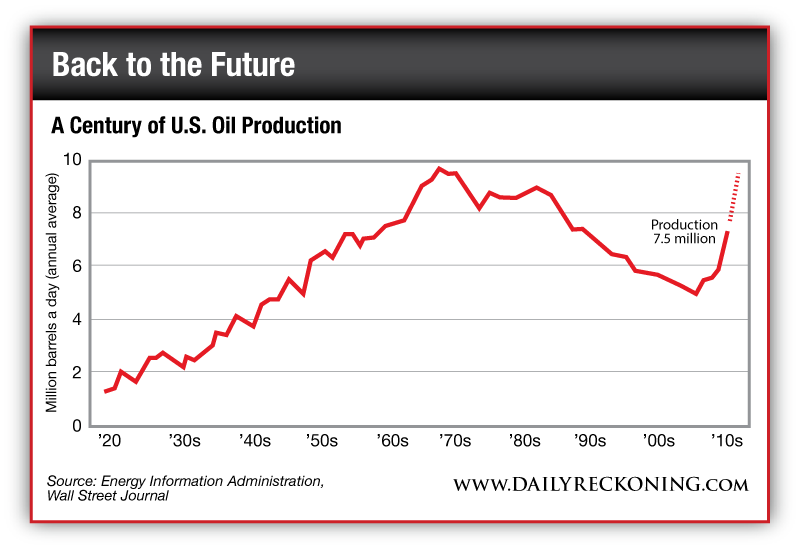
U.S. oil production averaged 7.5 million barrels per day during 2013. The increase over 2012 marked the biggest in U.S. history. Indeed, it’s the fourth-biggest annual increase by any country ever… and Saudi Arabia holds the top three spots.
And it only gets better from here. The peak year for U.S. crude production was 1970 — a little shy of 10 million barrels per day. As you see from the “Back to the Future” chart, the U.S. Energy Department projects the nation will once again equal that number by 2019.
In 2005 — only nine years ago — the United States imported 60% of its oil needs. By 2012, that number collapsed to 40%. Check out the chart nearby and you’ll see the percentage is set to shrink even more over the next quarter-century. And make a mental note — we’ll be coming back to this chart later.
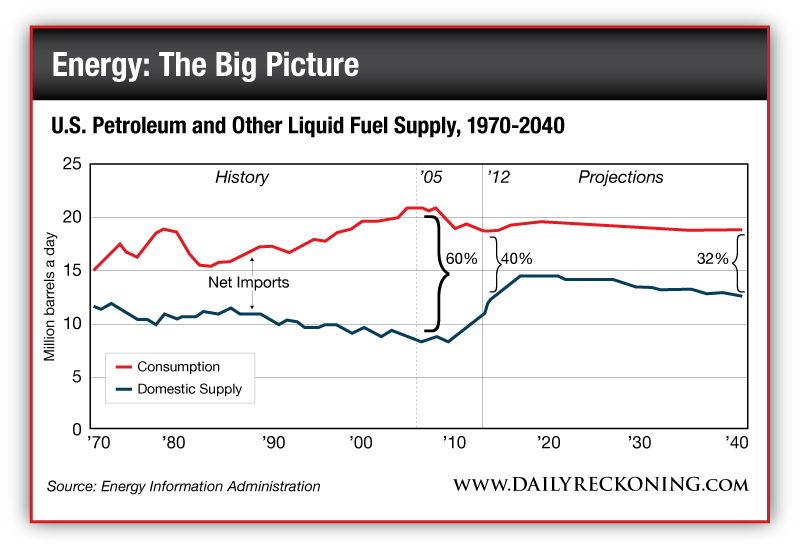
As we go to press, a barrel of oil fetches $100, give or take. So every 1 million barrels per day of new supply means $100 million less imported oil every year. Lower import costs, a lower trade deficit, fewer dollars flowing overseas — great news for the dollar, huh? It’s all good, right?
Well, yes… except that now the entire structure that’s supported the global financial system for 40 years is starting to come unglued.
Since 1974, the world has run on “petrodollars.”
The petrodollar arose from the ashes of the Bretton Woods system after President Nixon cut the dollar’s last tie to gold in 1971.
In the immediate post-World War II years, Bretton Woods made the dollar the world’s reserve currency — the go-to currency for cross-border transactions. If you were a foreign government or central bank, the dollar was as good as gold — for every $35 you turned in to the U.S. Treasury, you received one ounce of gold.
Chances are you know the rest of the story: Foreigners recognized Washington was printing too many dollars, the French wanted more gold than Washington was willing to give up and Nixon “closed the gold window.” But without gold, what would continue to cement the dollar’s position as the world’s reserve currency?
After the “oil shock” of 1973–74, in which oil prices shot up from $3 a barrel to $12, Nixon’s Secretary of State Henry Kissinger got an idea and convinced the Saudi royal family to buy in.
The deal went like this: Saudi Arabia would price oil in U.S. dollars and use its clout to get other OPEC nations to do the same. In return, the U.S. government agreed to protect Saudi Arabia and its allies against foreign invaders and domestic rebellions.
The appeal for the House of Saud was obvious — the weight of the U.S. military would keep the family’s 7,000 princes living in the style to which they’d become accustomed.
The appeal for Washington was more subtle — but no less important. Anyone who wanted to buy oil now needed dollars to do so. That meant perpetual demand for dollars and a cycle that goes like this…
- Dollars used to buy oil are deposited in the banking system to support international lending by the major banks
- That lending supports the purchase of American goods — everything from Boeing airplanes to Archer Daniels Midland corn. Oh, and U.S. Treasury debt. Can’t forget that.
“This gave the dollar a special place among world currencies, and in essence ‘backed’ the dollar with oil,” explained Rep. Ron Paul in a prescient speech on the floor of the U.S. House in 2006. “The arrangement gave the dollar artificial strength, with tremendous financial benefits for the United States. It allowed us to export our monetary inflation by buying oil and other goods at a great discount as dollar influence flourished.”
Then came his forecast: “The economic law that honest exchange demands only things of real value as currency cannot be repealed. The chaos that one day will ensue from our 35-year experiment with worldwide fiat money will require a return to money of real value. We will know that day is approaching when oil-producing countries demand gold, or its equivalent, for their oil, rather than dollars or euros.”
Strange as it might be to imagine… the great American energy boom is hastening that day’s arrival. More to come tomorrow…
Regards,
Source: Daily Reckoning
Follow us on Twitter: @blacklioncm
Subscribe to:
Posts (Atom)